

An AI writer with real citations you can trace and check
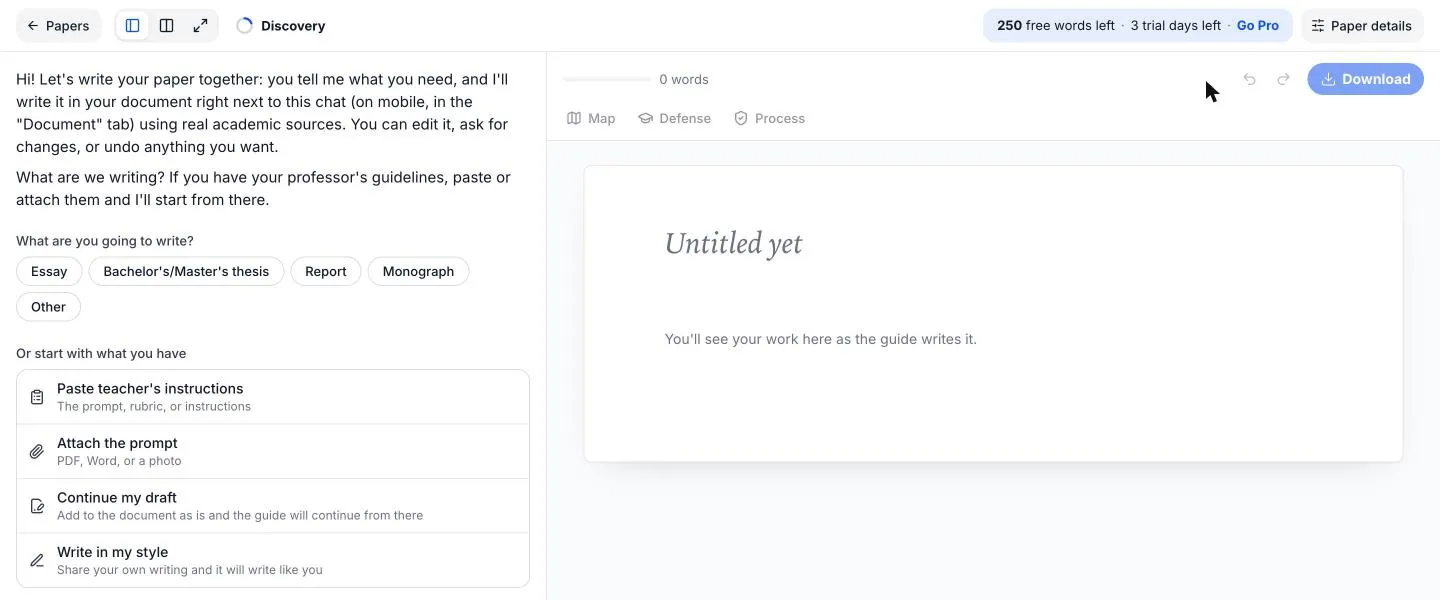
Aithor.io drafts your academic paper with you and only cites works that exist: it finds them in OpenAlex and Crossref and formats them in the style your course asks for. Every citation can be checked, because no AI gets them all right. Free: 3-day trial with 40 messages a day and about 250 words written by the guide per paper, no download; anything beyond that is cut off.
Sign up with Google or your email and start on the free plan, with its limits.
| Cites real academic sources from OpenAlex and Crossref |
| Over 200 million scholarly works (OpenAlex) |
| 10,851 citation styles (APA 7, MLA, Chicago, Harvard, IEEE, Vancouver, AMA, ABNT…) |
| In internal testing, citations not supported by their source fell from 22% to 16%: it does not promise zero errors |
| With Aithor Pro, Check against the source gives the exact sentence and page for each citation, only for articles with an open-access PDF (OpenAlex or Unpaywall) |
| With Aithor Pro you download Word, PDF or Markdown, with a title page, linked bibliography, footnotes and table of contents |
| Free: 3-day trial with 40 messages a day and about 250 words written by the guide per paper, no download; anything beyond that is cut off |
| With Aithor Pro: the full paper, Word or PDF download with a title page, Check against the source and a downloadable Process report |
How it works
- Paste your assignment brief, or upload it as a PDF, Word file or photo.
- Pick a title and adjust the outline the guide suggests.
- For each section, the guide searches OpenAlex (and Crossref when needed).
- Read every paragraph with its citations and keep only what works for you.
- Check the citations and download the paper with a reference list in your style.
Why a general AI chat makes up references
A language model writes whatever is most likely to come next. To the model, a reference is just another pattern: a surname, a year, something that looks like a title and a journal that sounds right. If it doesn’t look anything up first, it can produce a flawless-looking reference to a paper nobody ever wrote.
This has been measured. A study in Scientific Reports asked the two versions of ChatGPT available in 2023 for short literature reviews on 42 topics and traced all 636 references: 55% of those from the older version were fabricated, and 18% from the newer one [1]. A separate study of medical content found the same pattern of invented and inaccurate references [2]. In a dissertation, a reference that doesn’t exist isn’t a formatting slip. It’s one of the first things a marker checks. There’s more on this, with examples, in why AI makes up citations and how to catch fake ones.
Where Aithor.io gets its sources
The key difference is that Guided writing never cites from memory: it doesn’t recall a reference, it looks it up and copies the record’s details. For each section it runs a search in OpenAlex, an open index of scholarly literature [3]. Crossref, the registry behind the DOIs that publishers assign [4], is the fallback when OpenAlex isn’t available and the way it identifies works you add yourself by DOI or by pasting a reference. What it finds becomes your paper’s library, and the guide can only cite what’s in that library.
Three rules decide what makes it into your text:
- Language counts. Works in the language of your paper are ranked ahead; works in other languages drop down and only appear when there’s nothing better. If you need sources from a particular country, ask the guide.
- The abstract has to back it up. The guide reads each abstract and cites only when it supports the sentence. A second pass then checks every citation against its abstract and strips the ones that don’t hold up, so a sentence ends up uncited rather than propped up by a decorative reference.
- Your readings count too. Attach a PDF from your reading list, or add a source by hand, and it joins the library like any other work.
In-text citations follow your referencing style, and the reference list builds itself, with a link to each work.
What “real” actually means for a citation
When a tool says it cites real sources, it could mean three different things. It helps to keep them apart:
| Level | What is checked | Who checks it in Aithor.io |
|---|---|---|
| 1. The work exists | There is a record with those authors, that year and that title, usually with a DOI | Settled from the start: every reference comes from an OpenAlex or Crossref record, or from a source you added |
| 2. The reference is written correctly | Authors, year, title, journal and DOI follow the style you were given | Handled by the style you choose: the reference list formats itself |
| 3. The work says what the sentence claims | The cited content supports the point of the paragraph | The guide judges it from the abstract; you confirm it, and with Aithor Pro you get the exact sentence and page in the PDF |
Level one is where general chatbots fail most visibly. Level three is hard for anyone, including a person in a hurry, and the guide doesn’t fully solve it either. In internal testing, citations not supported by their source fell from 22% to 16%: it does not promise zero errors. So rather than promise you won’t need to check, we give you the tools to do it quickly.
Check every citation against the source
With Aithor Pro, Check against the source gives the exact sentence and page for each citation, only for articles with an open-access PDF (OpenAlex or Unpaywall). Open the citation card, press the button and you get a verdict plus the passage that supports it, highlighted in the PDF. If the article isn’t open access there’s no automatic check, and you’ll need to read it yourself. The full walkthrough is in verifying citations against the original source.
What else Guided writing does
Sources are what this page is about, but the guide works through the whole paper with you, from the brief to the file you hand in:
- It starts from your brief. Reads your brief from PDF, Word, PowerPoint, OpenDocument, text or photos (with OCR), up to 20 MB per file and 20 files per paper. From there it picks up the word count, the formatting rules and your title page details.
- The type of paper matters. Essay, dissertation, report, monograph or article: the outline it suggests fits what you’re actually writing.
- Length in words or pages. If you’re given a page count, it converts it to words: 300 words per page in 12-point type at 1.5 spacing (225 double-spaced and 450 single-spaced).
- YouTube videos as sources. Turns a YouTube video into a citable source (from its transcript).
- Tables, charts and images. Adds tables, data charts and Wikimedia Commons images with their author and license. It doesn’t generate AI images.
- Your draft, untouched. Imports your draft without rewriting it and carries on from where you left off.
- Targeted reviews. Ask for a review of coherence, transitions, length or spelling and grammar; each change is marked, and you accept or reject it.
- Ready to submit. With Aithor Pro you download Word, PDF or Markdown, with a title page, linked bibliography, footnotes and table of contents. If your course asks for APA, the formatting details are in writing a paper in APA format.
- Then the defence. Defense mode: asks you about your paper one question at a time and tells you what to review.
How to check a citation by hand
If a reference reaches you from somewhere else (a classmate, a chatbot, an old bibliography), you can verify it in a few minutes:
- Search the title or DOI in Crossref’s search or in OpenAlex. If it’s in neither, be suspicious.
- Compare authors, year, journal, volume and pages with your reference. A wrong year or surname is the most common slip.
- Open the work. Many articles have an open-access version in a university repository or on the journal’s site.
- Find the point you want to cite. If you quote a figure or a sentence, note the page.
- If you can’t read the work, don’t cite it as if you had. Find a source you can open.
To find more papers on your topic before you start, use the AI research assistant. If you’re writing a review, the AI literature review generator also documents the search and the screening.
Show how you wrote it, too
Sources are half of the trust question; the other half is process. The Process report sums up what you wrote and what the guide suggested. It measures what happened in the editor: it does not certify that no AI was used.
Aithor.io compared with a general AI chat
The table compares what Guided writing does with what a general-purpose AI chat does by default, with no special instructions or plug-ins.
| Criterion | Aithor.io | A generic AI chat |
|---|---|---|
| Searches academic databases for its sources | Yes | Partly |
| Every reference matches a work that exists | Yes | Partly |
| Only cites when the abstract supports the sentence | Yes | No |
| Shows the exact sentence and page in the PDF | With Aithor Pro | No |
| Reference list in the style your course requires | Yes | Partly |
| Word file with title page, footnotes and contents page | With Aithor Pro | No |
Limits and responsible use
- The guide decides each citation from the work's abstract, not the full paper. Reading what you cite is still your job.
- A real paper can still be cited for something it doesn't quite say. Check your citations before you submit.
- Check against the source only works for articles with an open-access PDF, and it comes with Aithor Pro.
- Open indexes don't hold everything. If your module reading list names a specific book or article, add it yourself.
- It doesn't replace your supervisor or your university's rules on AI use.
Frequently asked questions
Which AI cites real sources?
One that searches academic databases before it writes, instead of recalling references from memory. Aithor.io searches OpenAlex and Crossref and only cites works from that search or ones you added, so every reference points to a record you can open.
Can a citation be wrong even if the paper is real?
Yes. The paper may exist and still not say what the sentence claims, or say it with caveats. That's why the guide only cites when the abstract backs the sentence, and why you should read at least the abstract of each source before you hand the work in.
How do I check that a citation is real?
Search the DOI or the title in Crossref's search, compare authors, year and journal, then open the paper. With Aithor Pro, Check against the source does this for articles with an open-access PDF and shows you the sentence and the page.
Can it use my module readings?
Yes. Attach the reading as a PDF or Word file and it joins your paper's sources, so the guide can cite it. You can also add a work by pasting its DOI or filling in a source card by hand.
Which referencing styles does it support?
The common ones (APA 7, Harvard, MLA, Chicago, IEEE, Vancouver, AMA) plus thousands of journal and university styles. If your department has its own version of Harvard, look for it by name.
Is it free?
You can try it for free, with a set number of messages and words written by the guide. The trial doesn't renew and doesn't include downloads; the full paper, downloads and Check against the source come with Aithor Pro.
Will Turnitin flag it?
Nobody can promise what a detector will flag, and Aithor.io isn't built to hide AI use. If your university allows AI, declare it, and if you're asked to show how you worked, use the Process report.
Sources
- Fabrication and errors in the bibliographic citations generated by ChatGPT. Scientific Reports (2023). doi.org/10.1038/s41598-023-41032-5
- High Rates of Fabricated and Inaccurate References in ChatGPT-Generated Medical Content. Cureus (2023). doi.org/10.7759/cureus.39238
- OpenAlex: A fully-open index of scholarly works, authors, venues, institutions, and concepts. arXiv (2022). arxiv.org/abs/2205.01833
- Crossref: The sustainable source of community-owned scholarly metadata. Quantitative Science Studies (2020). doi.org/10.1162/qss_a_00022
Try it with your own paper
Try it on Aithor.io with the free plan, within its limits.
Start for free